
Living materials that can heal themselves - and maybe the planet too
on September 9, 2026
-
Contributors
Michaela Nesvarova -
Experts
Wilfried Weber, Andrés Díaz Lantada -
Categories
Articles, New Technologies -
Tags
biomaterials, biotechnology, self-healing, healthcare, construction, sustainability, bacteria, mycelium -
Share this
Materials that can grow, adapt, sense, and repair themselves, much like living tissue: however futuristic this might sound, ‘living materials’ are already a reality, and the EU is positioning itself at the forefront of this rapidly evolving field.
‘Engineered living materials’ (ELMs) are composed, either entirely or partly, of living cells. Unlike ‘bio-inspired materials’, they are literally alive and contain microorganisms, such as bacteria, algae or fungi.
Not only do these materials comprise of living organisms, but they also possess their capabilities: they can grow, self-organise, and self-repair when needed, and can potentially be ‘trained’ to react the way users need them to.
Such living materials can extract energy from the environment to form or assemble the material itself and can therefore potentially adapt to environmental clues and be more durable and sustainable than other materials. The application of materials with such properties could revolutionise various industries, from healthcare to infrastructure.
At first glance, ELMs look and feel similar to traditional materials such as leather or cardboard. On the inside, however, it is a whole other story, explains Prof. Dr. Andrés Díaz Lantada of the Technical University of Madrid, whose research is largely dedicated to bioinspired and living materials: “ELMs are materials in which living entities, such as bacteria or archaea, interact with abiotic component – the extracellular matrix,” he says.
This approach is similar to the one applied in tissue engineering, but “ELMs transcend tissue engineering because they have many different industrial applications,” says Professor Díaz Lantada. He highlights that ELMs have an impressively broad range of potential applications, spanning medicine, construction, robotics, energy, fashion and beyond.
Treating untreatable diseases
ELMs can contain a variety of cells with a great diversity of functionalities. Which organisms are used as the building blocks of ELMs therefore depends entirely on the application area, clarifies Prof. Dr. Wilfried Weber, Scientific Director at Leibniz Institute for New Materials and one of the leading experts in the field of ELMs.
“In medicine, for example, probiotic bacteria are very promising because these are organisms that already live in or on our body,” says Professor Weber. He explains that researchers are exploring bacteria-based ELMs as frontiers in therapeutic innovation. “ELMs give us the opportunity to treat previously untreatable diseases and to make treatments more effective, while making costs lower.”
As an example, Professor Weber mentions an FDA-approved product ENCELTO, which - thanks to the use of ELMs - is able to treat Macular telangiectasia (MacTel), a previously untreatable eye disease.
ELMs can be programmed to produce and release therapeutics inside the body on demand, responding to biological signals. As such, these new materials could change the world of pharmaceuticals, adds Professor Weber.
Prof. Dr. Wilfried Weber: “A lot of existing drugs are produced by living cells, so why not produce them directly where needed? We can transfer the genetic information of how to make a drug - such as growth factors or antibiotics - into bacteria. If we then integrate the bacteria into an ELM which we place in the body, it provides continuous supply of the therapeutic properties.” - Read the full interview with Wilfried Weber
If successful, patients would no longer need to take pills every day as the engineered bacteria placed inside the body would do the work for them.
Thanks to their unique properties which mimic those of natural materials, ELMs have the potential to transform medicine and healthcare. In fact, Díaz Lantada focuses primarily on medical applications of living materials. For instance, his research looks into implants that contain cells directly from the patient and could therefore help prevent rejection of implants after surgery.
Self-repairing constructions
On top of medicine, another sector where ELMs hold a big promise is construction, agree both experts. “In construction, civil engineering and architecture, there has already been a lot of promising results with the use of fungi because they grow their own extracellular matrix called mycelium,” explains Professor Díaz Lantada. “Moreover, there are some bacteria that can create self-healing concrete or cement.”
Such a living concrete is, in fact, already entering the market. If a structure, made of this concrete, cracks - as often happens due to changes in temperature - it doesn’t need to be actively mended. The organisms it contains can repair the cracks on their own in a matter of days. “The living concrete contains bacteria that are dormant and only become activated once they come into contact with water,” explains Professor Weber. “When activated, they grow and therefore repair the crack. Afterwards, the bacteria can go back to the spore state and wake up again only once the conditions have changed.”
This speaks to yet another key capability of ELMs. They are renewable. “They only need energy from the environment,” highlights Professor Weber. “This makes ELMs more sustainable – especially in the construction industry,” he adds. “Currently, 8% of the global CO2 emissions come from cement production. If we can use a biological solution, it’d therefore have a huge impact on the environment.”
The building materials and construction sector are the largest emitters of greenhouse gases, accounting for a staggering 37% of global emissions. ELMs could greatly reduce this carbon cost by using living organisms to aid material manufacturing via less carbon-intensive processes.
Other types of ELMs – ‘engineered living energy materials’ (ELEMs) - are specifically designed to potentially generate, convert, or store sustainable energy. In the world of fashion, living textiles could open the door to fabrics that can grow, change colour, or even self-repair, helping to reduce the carbon footprint of the industry.
Growth and challenges
ELMs are a fast-growing field, which is gaining worldwide attention. The World Economic Forum included engineered living therapeutics - a subset of ELMs - as one of the Top 10 Emerging Technologies of 2025.
A few years earlier, in 2021, the European Innovation Council (EIC) launched the Engineered Living Materials Pathfinder Challenge under the Horizon Europe framework programme. With this Pathfinder Challenge, the EIC aimed to propel Europe to the forefront of the emerging ELMs field and funded a variety of projects dedicated to overcome the technological challenges of ELMs and developing materials that are cheaper and more sustainable.
Despite the interest and quick progress, ELMs still face significant challenges in terms of deployment in society, including issues around scaling, regulatory pathways, and public acceptance.
At the moment, many ELMs are engineered by genetic means (e.g. scientists change the DNA in cells), spatial patterning (e.g. cells go into exact spots in a material), or chemical means (e.g. linking polymers with living cells, chemically controlling cell growth, or cross-linking to create strong support frames), and then they are 3D printed.
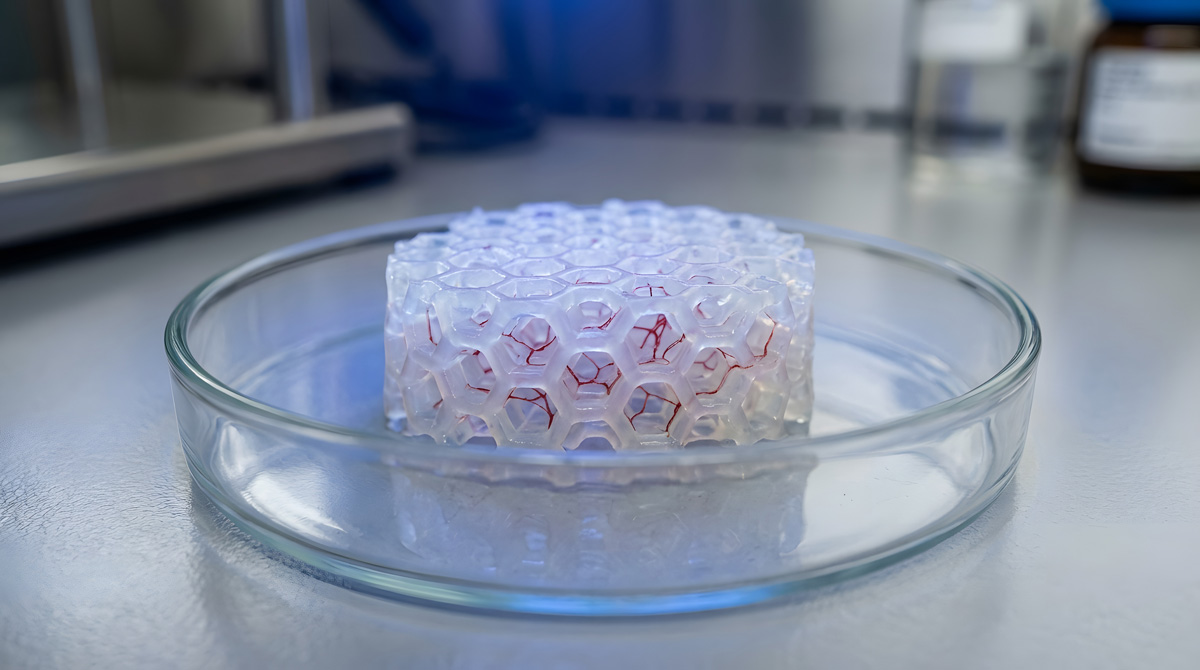
For certain types of ELMs, such as construction materials, it is possible to print or grow them at multi-meter scale within a few days. “With the use of additive manufacturing - a 3D printing technique where designs are built up layer by layer into a physical object - we can print the porous structures where the cells can grow,” explains Professor Díaz Lantada.
However, in some cases it continues to be a challenge to ensure that cells remain alive and to produce these materials at a larger scale. “In case of some ELMs, it is already challenging to create tiny structures in the lab. It can take weeks to grow a structure of 1 cm2. Scaling up the production is definitely one of the main challenges,” explains Díaz Lantada. “Moreover, to reach the end users in a safe way, we need new regulations.”
On top of regulatory challenges, which might hinder a wide-range application of ELMs, some scientists worry about the societal acceptance of living materials. “Some medical devices fail simply because of their colour. There was a well-known case of a polymer that worked perfectly but it was bright orange and surgeons would not use it because they were afraid of it being toxic. Now imagine that a similar device contains bacteria,” says Professor Díaz Lantada.
Prof. Dr. Andrés Díaz Lantada: "For instance, if we use ELMs in construction, it might be difficult to explain to society how a building incorporates bacteria that also heal the building. It’s important to remember that these are non-pathogenic bacteria, not dissimilar to the ones you can find in yoghurts, but the communication with society is important and might be a challenge." - Read the full interview with Andrés Díaz Lantada
Regardless of possible obstacles, the experts believe that ELMs will soon become a part of our daily lives. Some already are in use, for example in healthcare: “We are already reaching patients,” says Prof. Díaz Lantada. “There are tissue engineering solutions that are already being applied, for example for skin implants, bone tissue engineering and articular joint repair.”
Professor Weber agrees: “ELMs are now on the brink of getting into industries and the first products are already on the market. In ten years, we will see these materials on the market in different sectors. It’s a strongly growing area.” He is particularly optimistic about Europe’s role in the sector. “Europe is well positioned and has an advantage in this field. We should ensure that we maintain this advantage.”
Related content: