
The art of Arctic science
on March 25, 2026
-
Contributors
Monica Hoyos Flight -
Experts
Jørgen Peder Steffensen, Lukasz Larsson Warzecha -
Categories
Articles, Environment -
Tags
arctic, climate, greenland, history, ice, photography, research, science -
Share this
As Arctic researchers gather in Aarhus, Denmark, for the annual Arctic Science Summit Week (25/3-1/4/2026), the European Science-Media Hub explores the benefits of visual storytelling to engage audiences worldwide with the urgency and significance of scientific work. This article features photos about Arctic ice research, which have been published in National Geographic.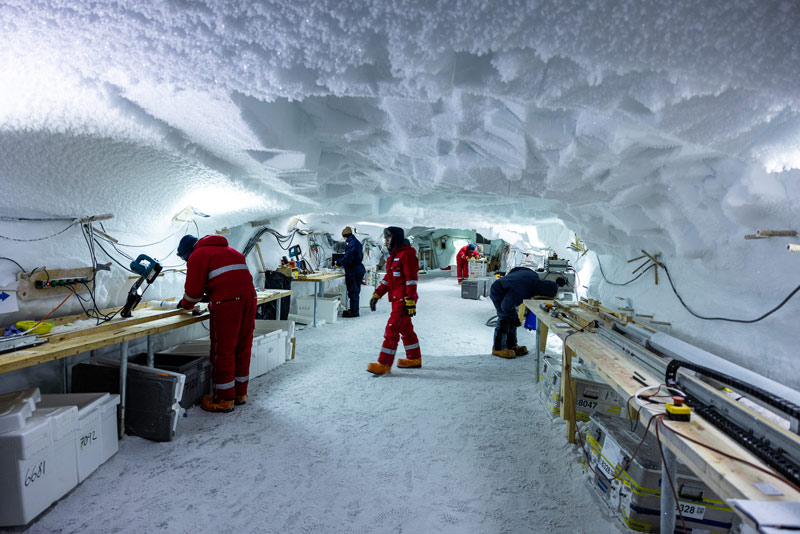 Scientists at the East Greenland Ice-Core Project (EastGRIP) work in the underground science trench at EastGRIP camp on July 28, 2022. (Photo by Lukasz Larsson Warzecha)
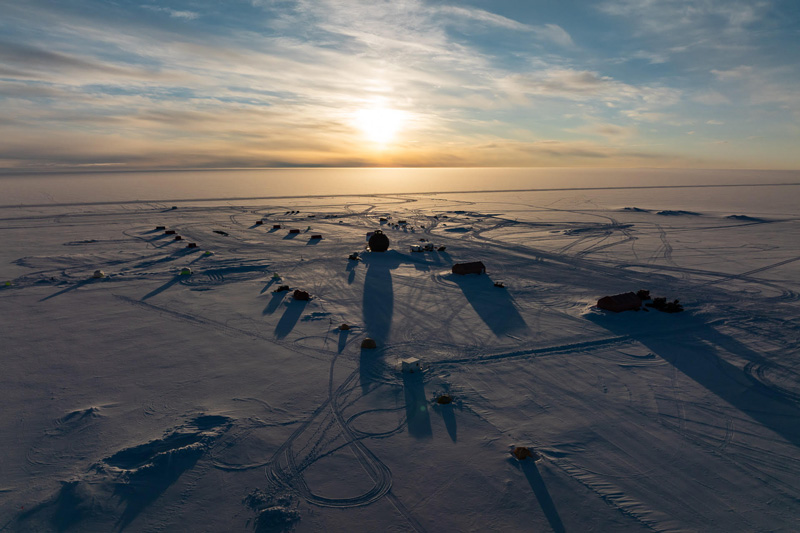 An aerial view of the East Greenland Ice-Core Project (EastGRIP) camp at midnight. (Photo by Lukasz Larsson Warzecha)
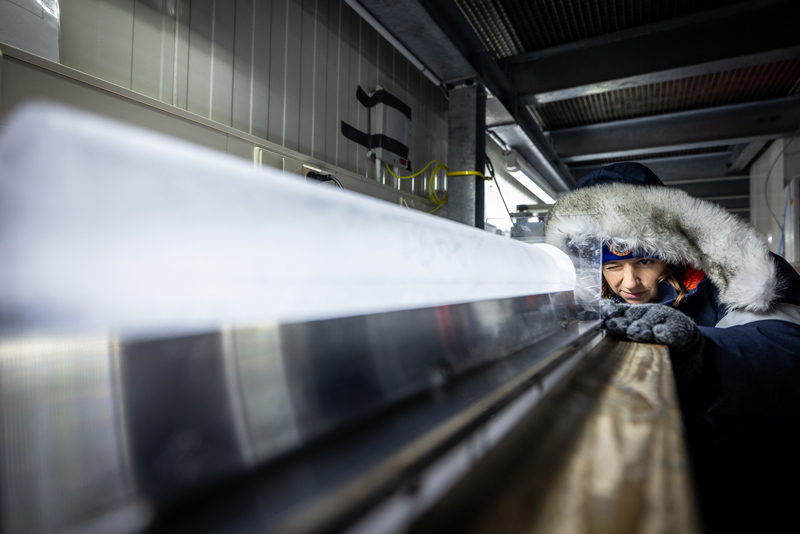 Tamara Gerber (Niels Bohr Institute) aligns core sections before processing on the morning of October 23, 2023, in Bremerhaven, Germany, at the ice laboratory of the Alfred Wegener Institute, where ice cores from the East Greenland Ice Core Project are handled. (Photo by Lukasz Larsson Warzecha)
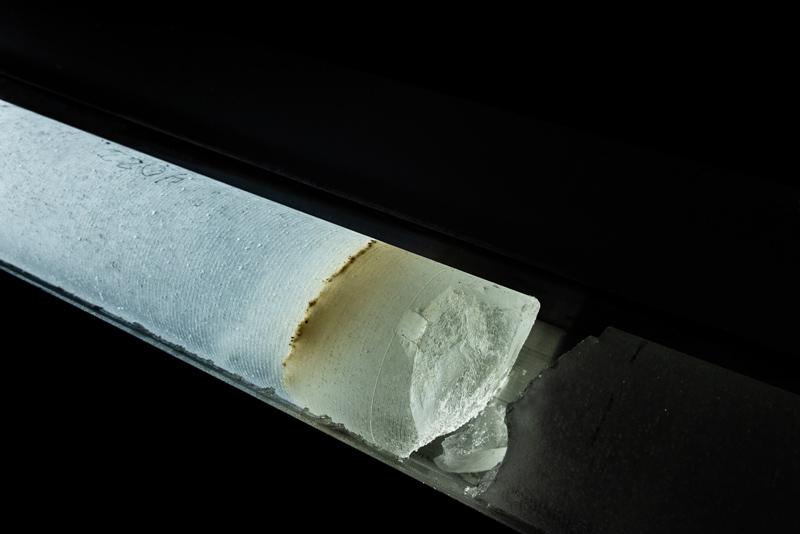 An ice core from a depth of 2215 meters with a prominent NAAZ II (North Atlantic Ash Zone) layer of volcanic ash, deposited ca. (Photo by Lukasz Larsson Warzecha)
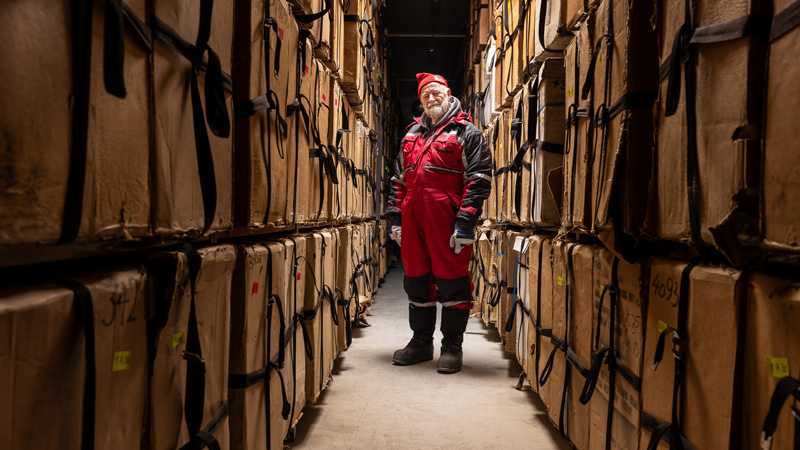 Professor Jørgen Peder Steffensen in ice core library. (Photo by Lukasz Larsson Warzecha)
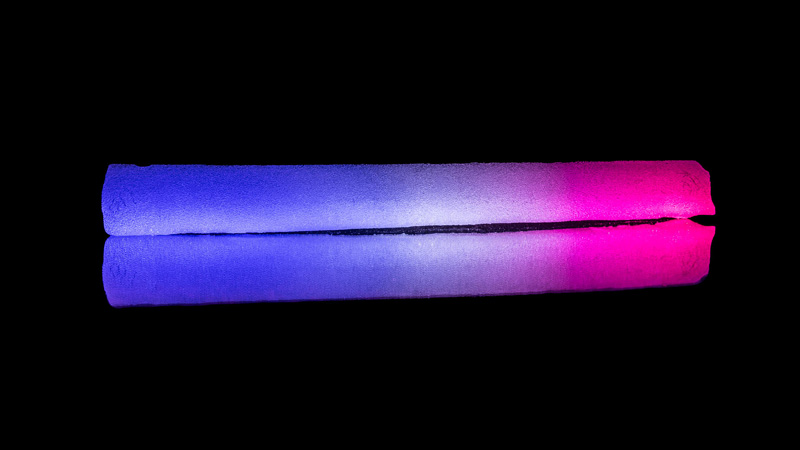 This core from Greenland’s ice sheet, lit to mimic France’s tricolour flag, contains sulfuric acid from the volcanic eruption in 1783, which affected harvests in Europe the following years contributing to spark the French Revolution. (Photo by Lukasz Larsson Warzecha)
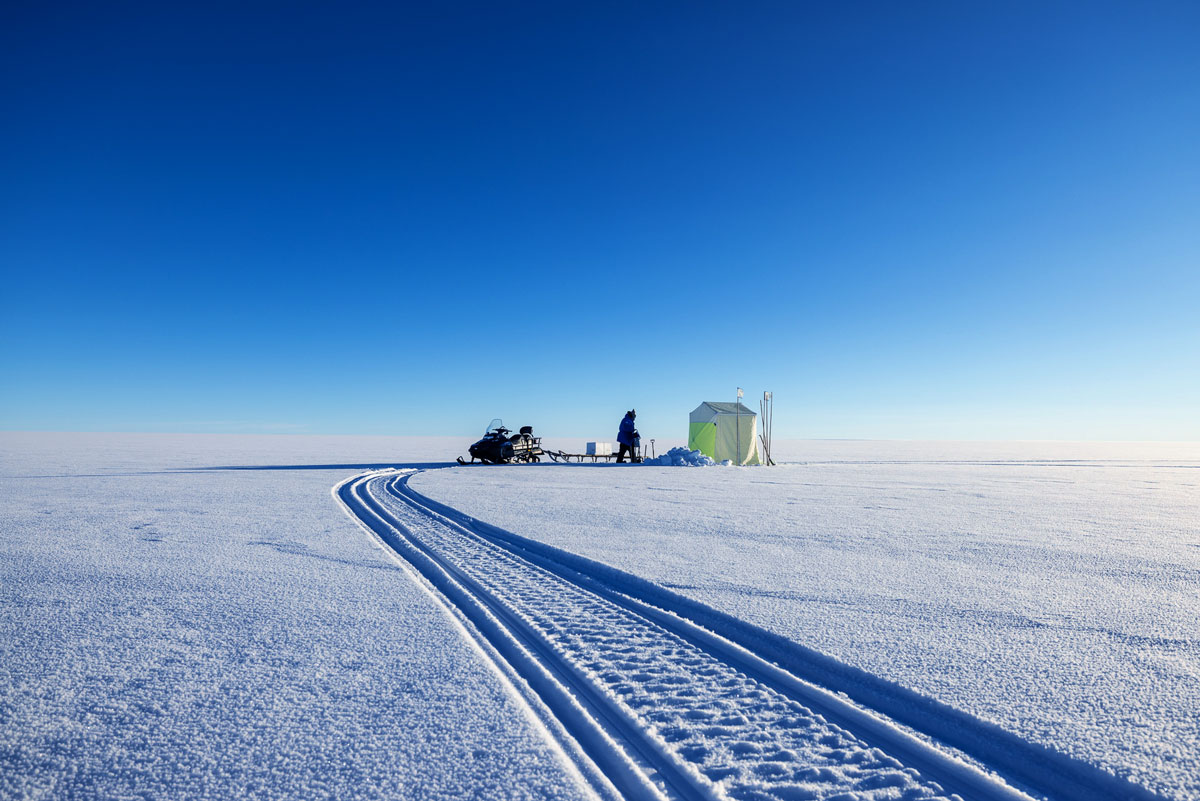
In 2022, photographer Lukasz Larsson spent three weeks on Greenland’s Ice Sheet with researchers from the East Greenland Ice-Core Project (EastGRIP).
Scientists at the East Greenland Ice-Core Project (EastGRIP) work in the underground science trench at EastGRIP camp on July 28, 2022. (Photo by Lukasz Larsson Warzecha)During his stay he documented life at the camp and learnt all about ice core research. His striking ice-core portraits have been published in National Geographic and featured in photo exhibitions in Denmark and the United Arab Emirates.
These images not only raise public awareness about the importance of climate research in the Arctic, but also provide a glimpse into historical events captured in ice cores.
Arctic exploration can be traced back to 325 BC when a Greek sailor ventured north of the British Isles and encountered the "Frozen Sea". While in the early 20th century Arctic exploration was largely driven by political and commercial interests, in the last 40 years the focus has shifted towards understanding the impacts of climate change on the region, and the implications for global sea levels and weather patterns.
Larsson’s own journey into the heart of Arctic research began during the COVID-19 pandemic, when he was looking for new opportunities to use his skills in commercial and outdoor photography to tell meaningful stories. He was delighted, if slightly daunted, by the invitation to join the EastGRIPteam led by Dorthe Dahl-Jensen and Jørgen Peder Steffensen in the centre of the East Greenland ice stream for the 2022 season.
An aerial view of the East Greenland Ice-Core Project (EastGRIP) camp at midnight. (Photo by Lukasz Larsson Warzecha)What ensued was an unforgettable experience. Larsson became an integral part of the team, participating in daily chores and capturing intimate moments of camp life, from birthday celebrations to waking up in the tents. By portraying the human side of the scientific endeavour in the Arctic, his photojournalistic images foster a deeper appreciation for climate research.
Lukasz Larsson, contributor to National Geographic magazine and award-winning documentary photographer and cinematographer:
“I think a lot of people confuse climate research with weather forecasting, so I was keen to clarify the difference, highlight the depth of the work being undertaken and the characters behind it.”
Read the full interview with Lukasz Larsson
Ice coring: going back in history
Tamara Gerber (Niels Bohr Institute) aligns core sections before processing on the morning of October 23, 2023, in Bremerhaven, Germany, at the ice laboratory of the Alfred Wegener Institute, where ice cores from the East Greenland Ice Core Project are handled. (Photo by Lukasz Larsson Warzecha)Steffensen, a leading geophysicist and glaciologist at the Centre for Ice and Climate at the Niels Bohr Institute, University of Copenhagen, guided Larsson through the scientific intricacies of ice coring. Since embarking on his first Arctic research project in 1980, Steffensen has been dedicated to extracting and analysing Greenland’s ice cores - vertical cylinders of glacial ice.
Ice cores contain layers representing yearly snowfall. Like tree rings, they provide a natural record of environmental conditions, including temperature and atmospheric gases, over time. Volcanic events are key for dating ice cores as they lead to the deposition of layers of sulfuric acid and changes in the ice’s conductivity.
An ice core from a depth of 2215 meters with a prominent NAAZ II (North Atlantic Ash Zone) layer of volcanic ash, deposited ca. (Photo by Lukasz Larsson Warzecha)
Jørgen Peder Steffensen, professor of ice-core-related research at the Centre for Ice and Climate at the Niels Bohr Institute at the University of Copenhagen (Denmark): “By analysing the chemical and physical properties of the layers within ice cores, we have created an accurate, high-resolution timeline of Greenland’s atmospheric conditions that extends back 60,000 years.That is half way into the last ice age!” - Read the full interview with Jørgen Peder Steffensen
Ice core research confirms the accelerated pace of global warming. The frequency of ice-sheet-wide surface melt events, which can be identified in ice cores by the absence of air bubbles, has increased dramatically. There was only one such event between the year 1000 AD and 2000 AD, in 1889. However, since the year 2000, Steffensen and his team have witnessed five.
Professor Jørgen Peder Steffensen in ice core library. (Photo by Lukasz Larsson Warzecha)
Using historical climate data to forecast the future
Accurate records of Earth’s past climate are crucial for refining climate models and predicting future environmental conditions. Researchers can validate these models by simulating past conditions to see if they can replicate the data observed in ice cores.
This type of research is pivotal for estimating future sea level rises more accurately. At present, the Intergovernmental Panel on Climate Change of the United Nations estimates that by the year 2100, sea levels will rise approximately 90 cm, with a possible variation of plus or minus one metre. Any reduction to this uncertainty could very quickly lead to the implementation of effective measures to protect coastal communities.
In 2023, the EastGRIP project team successfully drilled through 2670 meters of ice to reach the bedrock below. Surprisingly, and rather worryingly, they discovered that that the bottom of the ice sheet is not frozen to the bedrock as previously thought. Instead, it is sliding as a block towards the coast. This finding suggests that as temperatures increase, sea levels could rise far faster than currently expected, and must be incorporated into climate models.
The project Steffensen has just embarked on, Green2Ice, will focus on analysing the oldest ice cores, near the bedrock, as well as samples of the bedrock itself, with the goal of understanding the stability of Greenland’s ice sheet and the environmental conditions when Greenland was ice-free (around 400,000 years ago).
Ice core research beyond climate change
Ice cores capture more than the Earth’s climate history, they provide a unique record of the history of humanity. One of Steffensen’s most surprising findings involved tracing the economic fluctuations of the Roman Empire by measuring the levels of lead, a by-product of ancient silver smelting processes, in ice cores.
Upon returning to Sweden, Larsson decided to explore these links to history and archaeology further, leading what later became the feature story ‘The race to save secrets trapped in ice’ published in National Geographic. Together with his wife, he drew up a list of historic events they would attempt to visually document in ice core samples stored the Niels Bohr Institute’s ice core library. With Steffensen’s help, they were able to locate and photograph ice cores containing the ash from a volcanic eruption that precipitated years of food instability in Europe and contributed to the onset of the French Revolution, as well as cores containing snow dating back from 1BC-1AD.
This core from Greenland’s ice sheet, lit to mimic France’s tricolour flag, contains sulfuric acid from the volcanic eruption in 1783, which affected harvests in Europe the following years contributing to spark the French Revolution. (Photo by Lukasz Larsson Warzecha)“Most people find the idea that the history of humanity is written into the ice cores fascinating and more tangible than abstract scientific concepts. In the case of the ice-core portraits, it was all about turning scientific samples into a conversation starter,” he reflects.
Steffensen is delighted with the results of this collaboration and recognises the crucial role of reaching audiences beyond the scientific community to highlight the importance of Arctic science. “Lukasz has captured the aesthetics of ice coring. Through clever use of light, he has managed to change people’s perception of ice cores. His ice portraits convey that ice core research is not just about understanding climate but also the history of human civilisation,” he says.
Useful links:
• “The race to save secrets trapped in ice”, National Geographic
• Arctic Science Summit Week
Related content:
• A scientist's opinion: Interview with photographer Lukasz Larsson on visual storytelling
• A scientist's opinion: Interview with geophysicist and glaciologist Professor Jørgen Peder Steffensen on ice core research