
AI and the future of journalism: Balancing innovation and responsibility
on June 17, 2026
-
Contributors
Diandra Vanigioli, Francesco Suman -
Experts
Jyri Kivimäki, Svea Eckert -
Categories
Articles, Artificial Intelligence, Events -
Tags
ai, automation, democracy, esmh summer school, esmh summer school 2026, ethics, factchecking, genai, journalism, media, newsrooms, trust -
Share this
The advent of generative artificial intelligence (AI) is already transforming society across a wide range of sectors and journalism is no exception. The challenge is twofold: AI can both support and disrupt journalistic work, acting at once as a powerful tool and a potential competitor. At the same time, journalists carry the responsibility of helping the public understand what AI really is – and finding the right angle to discuss it remains far from straightforward.
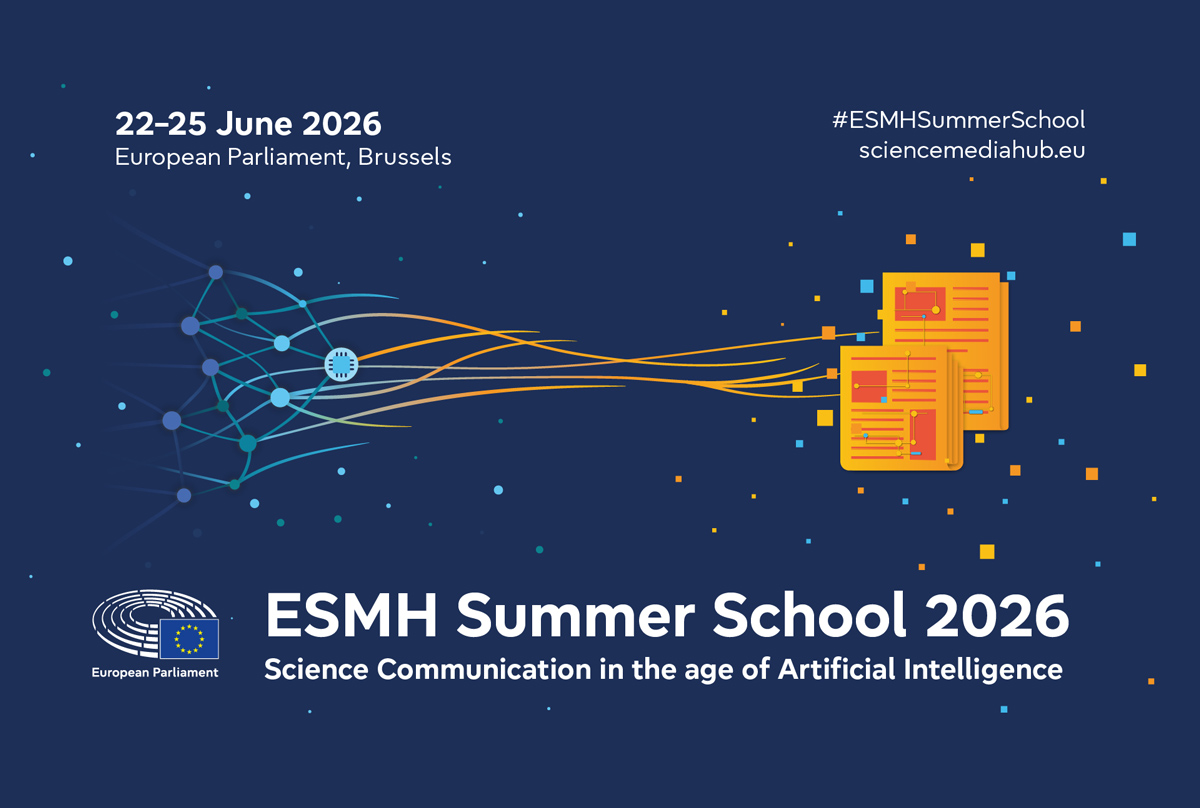
This year’s European Science-Media Hub Summer School, taking place at the European Parliament in Brussels from 22 to 25 June, aims precisely to address these challenges. Bringing together young science journalists from all over Europe, it will provide a space to discuss AI’s impact on journalism, public trust and democracy.
We spoke with two workshops leaders from the Summer School about how AI is transforming newsrooms and the importance of responsible AI journalism.
Jyri Kivimäki is the Head of AI Development at Yle, the Finnish national public broadcasting company. He understood early on that AI would reshape journalism and profoundly impact newsrooms, but decided to turn disruption into an opportunity. Rather than resisting the transformation, he embraced the change and proactively learnt how to master AI to his advantage, using AI assistants to help automate routine tasks, analyse big data sets, and version content across different platforms.
“AI is a massive shift for journalism. It makes things possible that simply weren't before” says Jyri Kivimäki, who believes that AI can add value at every stage of the journalistic workflow - from research and production to storytelling and postproduction, including audience engagement. “AI helps us reach audiences who might have had trouble accessing reliable information in the past – say, because of language barriers or physical limitations. Think of translations and subtitles.”
But Jyri is also well aware of the challenges that come with AI, such as verification: “The importance of visual fact-checking in photo and video journalism grows every day. As journalists, we need to stay sharp and learn new tricks to keep pace with the latest advancements”.
He has been working with his colleagues at Yle on the development of their own GenAI tool, tailored to the newsroom’s editorial needs and workflow: YleGPT. “We wanted every single person at Yle to be able to learn and understand AI technology hands-on, in a safe environment” he says. “With YleGPT, you can transcribe your interview recordings and use various AI assistants powered by language models – a drafting assistant, a news wire assistant, one that turns podcasts into text articles, an archive search assistant, and many more”. To successfully transition to an AI-powered newsroom, offering journalists real learning opportunities to use new tools and adopt new ways of working is essential.Jyri Kivimäki, Head of AI Development at Yle, the Finnish national public broadcasting company: “Right now, in many large (news) organisations AI is still very much tied to individual tools and personal workflows. It is not yet a structural part of how newsrooms operate, which can easily lead to inequality within teams. One reporter might be using AI at every stage of their work, while the colleague sitting next to them still handles AI-friendly routine tasks manually. That makes newsroom management tricky.” - Read the full interview with Jyri Kivimäki
Familiarity with AI tools certainly helps journalists gain a more realistic understanding of their capabilities and limitations. Yet the impact of AI extends far beyond the newsroom, and helping audiences grasp its broader implications remains a complex journalistic challenge.
Svea Eckert is a freelance tech journalist and expert for NDR/ARD television, Germany’s national public broadcaster. She is currently working on a project titled ‘Between Hype and Doom: Why Good Journalism on AI (Still) Falls Short’, supported by the Stiftung Mercator Fellowship Program.
According to Svea, the conversation around AI often only oscillates between ‘AI will change everything’ and ‘AI is dangerous’: “There's not enough grounding: which are the systems and who are they used by? Who is doing what with whose data? Who is accountable to whom? These questions don't get asked enough”.
Svea believes that in-depth reporting on the power structures behind AI is still missing, and this is something she will explore in her workshop at the 2026 ESMH Summer School. “The market is extremely concentrated – from chip production to software and AI models – and controlled by a small number of very powerful companies, and mostly men. Keeping this in mind helps avoid falling into the hype-or-doom narrative, which often originates from the companies themselves. As journalists, our role is to look behind the curtain and report on what is actually happening and how it affects people and society”.Svea Eckert, freelance tech journalist and expert for NDR/ARD television, Germany’s national public broadcaster: “The core questions I'm trying to answer are: what gets in the way of nuanced, accurate AI journalism? Structural constraint or editorial pressure? Is it a lack of expertise? Is it time? I mostly conduct interviews with journalists across German newsrooms, and what I see is a real tension between the speed of the news cycle and the time it takes to genuinely understand the technology. This often affects the depth of reporting.” - Read the full interview with Svea Eckert
Science journalists can play an important part in helping audiences understand the complexities of AI, but she cautions viewing expertise in isolation. “A specialist who cannot communicate clearly is not very effective in a mainstream newsroom, but neither is a generalist who does not fully understand the technology they are covering” she notes. “We cannot stay siloed within science journalism, political journalism, economic journalism and so on. It is important to stay in close contact with each other, exchange knowledge, and understand what each of us is doing.”
At the 2026 ESMH Summer School, both Jyri Kivimäki and Svea Eckert will offer concrete, hands-on and interactive examples of using AI as a journalistic tool. “Responsible use of AI is very close to my heart, so the ethical dimension is embedded throughout the workshop – not as a separate lecture, but woven into everything we will do” says Jyri. Similarly, Svea emphasises the importance of a human-centred approach, which she believes allows journalists to “open the curtain, and get a sense of how to engage with AI topics without falling for hype or doom narratives”.
Useful link:
• ESMH Summer School programme
Related content:
• Covering AI: behind the curtain of hype and doom - interview with Svea Eckert
• Bringing tailored AI tools into the newsroom - interview with Jyri Kivimäki